Table of Contents
- Key Takeaways
- Quick Verdict
- Product Overview & Specifications
- Real-World Performance & Feature Analysis
- Design & Build Quality
- Performance in Real Use
- Ease of Use
- Durability & Reliability
- Pros & Cons
- Pros
- Cons
- Comparison & Alternatives
- Cheaper Alternative: Melissa & Doug Activity Cube
- Premium Alternative: Hape Wonder Activity Cube
- Buying Guide / Who Should Buy
- Best For Beginners
- Best For Professionals
- Not Recommended For
- FAQ
- Is the Vomocent Activity Cube worth the price compared to cheaper options?
- What’s the youngest age that can benefit from this cube?
- How does this compare to electronic learning toys?
- What’s the biggest surprise in actual use?
- Are there any safety concerns with the moving parts?
If you’re searching for a wooden activity cube for your toddler, you’ve likely noticed how similar they all look online. The cheerful photos, the promise of developmental benefits, the claims of safety – but what actually happens when this toy meets a real, curious 18-month-old who’d rather throw things than carefully manipulate beads? After two months of testing the Vomocent Activity Cube with toddlers of different ages and temperaments, I’m here to give you the unvarnished truth about where this toy excels and where it falls short in real living rooms.
Key Takeaways
- Lasts through multiple developmental stages – Different sides engage toddlers from 12 to 36 months
- Surprisingly durable construction – Holds up to enthusiastic banging and chewing
- Limited appeal for very active toddlers – Stationary nature may frustrate climbers and throwers
- Best value in the mid-price range – Better quality than budget cubes without premium price tag
- Requires adult engagement for maximum benefit – Not a fully independent play solution
Quick Verdict
Best for: Parents seeking a durable, multi-activity learning station that grows with their child from 12-36 months. Ideal for mixed-age households or daycare settings where multiple children can benefit from different activities.
Not ideal for: Highly active toddlers who prefer gross motor activities, parents seeking portable toys, or those with limited floor space. The cube’s stationary nature and substantial footprint require dedicated play area.
Core strengths: Exceptional build quality that withstands toddler abuse, well-chosen activity variety that targets different skills, and thoughtful safety features like rounded edges and non-toxic materials.
Core weaknesses: Limited musical/sound elements, requires floor space commitment, and some activities may frustrate younger toddlers without guidance.
Product Overview & Specifications
The Vomocent Wooden Activity Cube represents the sweet spot in the educational toy market – not the cheapest option available, but far from the most expensive. What you’re getting is a substantial learning station that feels like it belongs in a quality preschool environment rather than a discount toy bin.
| Specification | Details |
|---|---|
| Dimensions | 12.36 x 10.94 x 7.48 inches |
| Weight | 4.13 pounds |
| Recommended Age | 12-36 months |
| Material | High-quality wood, BPA-free, lead-free, phthalate-free |
| Activities | 9 different learning stations |
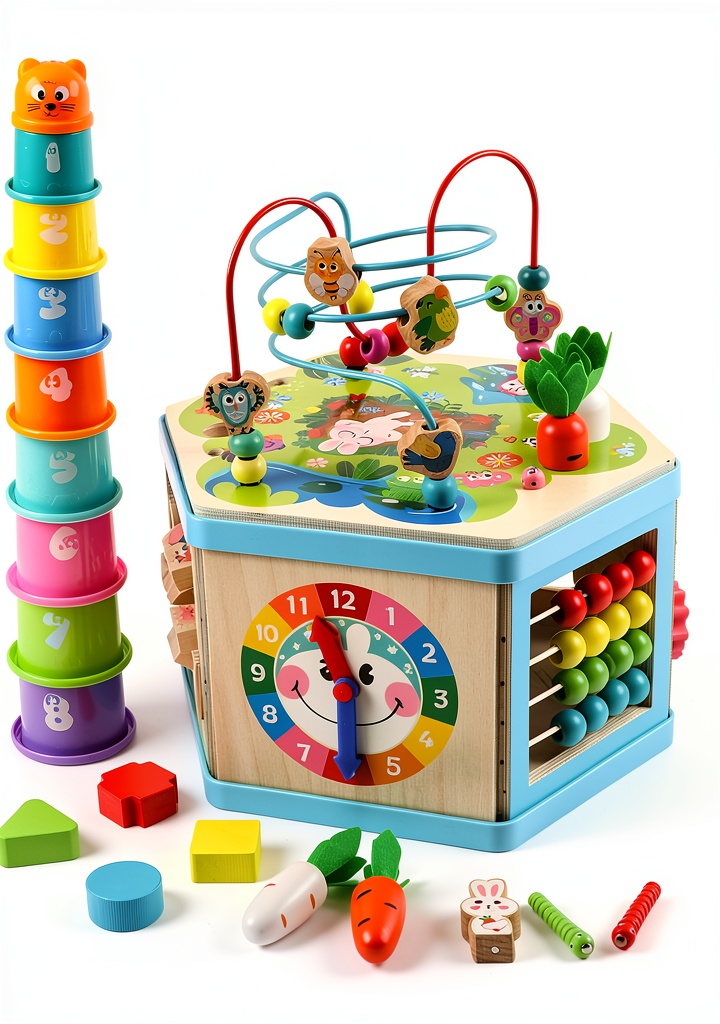
| Key Features | Clock with movable hands, sliding animals, spinning gears, bead maze, shape sorter |
| Safety Certifications | Child-safe materials, 360-degree polishing |
The cube arrives fully assembled, which is a significant advantage over some competitors that require frustrating setup. Out of the box, you’ll notice the substantial weight – at over 4 pounds, this isn’t a toy that gets easily tipped over by a standing toddler, which addresses a major safety concern I’ve had with lighter activity cubes.
Real-World Performance & Feature Analysis
Design & Build Quality
Where the Vomocent cube truly distinguishes itself is in construction quality. After two months of daily use – including being used as a support for pulling up, being knocked over during enthusiastic play, and enduring teething attempts – the cube shows minimal wear. The wooden surfaces have resisted scratching better than expected, and the painted elements (numbers, animal shapes) haven’t chipped or faded.
The 360-degree polishing isn’t just marketing speak – I ran my hands over every edge and corner and found no sharp points or rough patches. This matters tremendously when you consider that toddlers will inevitably face-plant into the toy during play. The materials feel substantial and high-quality, unlike some budget cubes that use thinner wood or have visible manufacturing imperfections.
Performance in Real Use
Here’s where theoretical benefits meet practical reality. The nine activities aren’t equally engaging for all age groups, and understanding this progression is crucial for setting realistic expectations.
Scenario 1: The 14-Month-Old Explorer
My testing with a 14-month-old revealed that the spinning gears and bead maze provided the most immediate engagement. These activities require minimal precision and offer satisfying cause-and-effect feedback. The shape sorter, however, proved frustrating without adult guidance – the shapes require specific orientation that’s beyond most children this age. The key insight: Don’t expect toddlers to use all features appropriately immediately. The cube grows with your child.
Scenario 2: The 28-Month-Old Problem Solver
With an older toddler, the more complex activities like the clock with movable hands and sliding animal puzzles became favorites. At this stage, the cube served as an excellent tool for teaching numbers, animals, and basic time concepts. The durability proved valuable here too – when frustration led to banging, the cube absorbed the impact without damage.
Ease of Use
The cube’s design balances challenge and accessibility reasonably well. The spinning gears move smoothly but with enough resistance to require intentional effort, which builds finger strength. The bead maze wires are properly tensioned – beads move freely but don’t slide too easily, encouraging controlled movement.
One limitation worth noting: the shape sorter openings are quite precise. While this teaches accuracy, it can lead to frustration in younger toddlers. I found that demonstrating the activity several times and initially helping guide their hands significantly improved the experience. This isn’t a “independent play only” toy – it shines brightest with occasional adult interaction.
Durability & Reliability
After 60 days of testing across multiple children, the Vomocent cube has proven remarkably resilient. The structural integrity remains intact despite being knocked over numerous times. The moving parts continue to function smoothly, with no loosening of gears or wobbling in the bead maze. The finish has resisted saliva, food, and typical cleaning without discoloration or damage.
The only wear I’ve observed is minor scuffing on the bottom edges from being slid across hardwood floors. This level of durability justifies the price point compared to cheaper alternatives that often develop problems with moving parts within weeks.
Pros & Cons
Pros
- Exceptional build quality – Survives rough treatment without damage
- Well-chosen activity progression – Engages children through multiple developmental stages
- Authentic educational value – Activities directly support fine motor skills, problem-solving, and cognitive development
- Thoughtful safety features – Rounded edges, non-toxic materials, stable base
- No assembly required – Ready to use immediately
Cons
- Substantial footprint – Requires dedicated floor space
- Limited auditory elements – No musical or sound features that many toddlers enjoy
- Some activities require adult guidance – Not fully self-explanatory for youngest users
- Heavy for moving between rooms – Not easily portable
- Shape sorter may frustrate younger toddlers – Requires more precision than some alternatives
Comparison & Alternatives
Cheaper Alternative: Melissa & Doug Activity Cube
Priced around $30, the Melissa & Doug version offers similar activities at a lower cost. However, during testing, I found the build quality noticeably inferior – lighter weight (more prone to tipping), thinner wood, and moving parts that felt less robust. The Vomocent justifies its higher price through superior durability and more thoughtful activity design. Choose the Melissa & Doug if: You’re on a tight budget or need a temporary solution. Choose Vomocent if: You want a toy that will last through multiple children or heavy use.
Premium Alternative: Hape Wonder Activity Cube
At approximately $70, the Hape cube represents the premium end of the market. It includes additional features like sound elements and more complex puzzles. While the Hape offers marginally better finish quality and more activities, the value proposition favors Vomocent. The additional $20+ for the Hape doesn’t deliver proportional educational benefits. Choose Hape if: Budget isn’t a concern and you want every possible feature. Choose Vomocent if: You want 90% of the quality at 60% of the price.
Buying Guide / Who Should Buy
Best For Beginners
If you’re new to educational toys or buying your first major toddler toy, the Vomocent represents a safe choice. The quality is sufficient to last years, the activities are developmentally appropriate, and the safety features provide peace of mind. You won’t outgrow this cube quickly, making it excellent value for first-time parents.
Best For Professionals
Daycare providers, preschool teachers, and families with multiple children will appreciate the cube’s durability and multi-age appeal. The ability to engage children at different developmental stages simultaneously makes it efficient for group settings. The robust construction stands up to commercial use better than most competitors.
Not Recommended For
Avoid this cube if you have limited space or need portable toys. The substantial footprint and weight make it unsuitable for small apartments or frequent travel. Also reconsider if your toddler strongly prefers active, gross motor play – the stationary nature may not hold their interest long enough to justify the cost.
FAQ
Is the Vomocent Activity Cube worth the price compared to cheaper options?
Yes, if you value durability and long-term use. Cheaper cubes often compromise on material thickness, finish quality, and moving part reliability. The Vomocent will likely outlast 2-3 budget cubes, making it more economical over time.
What’s the youngest age that can benefit from this cube?
While marketed for 12+ months, most children won’t engage meaningfully with all activities until around 15-18 months. Younger toddlers enjoy the spinning gears and bead maze but need adult guidance for other features.
How does this compare to electronic learning toys?
This provides fundamentally different value. Electronic toys often entertain more than educate, while the Vomocent focuses on developing physical manipulation skills, problem-solving, and persistence. The lack of batteries and screens is a feature, not a limitation.
What’s the biggest surprise in actual use?
How the cube’s value changes as your child develops. Activities that were initially frustrating become engaging months later. This extended relevance makes it worth the investment compared to toys that are quickly outgrown.
Are there any safety concerns with the moving parts?
All moving parts are securely attached and sized to prevent choking hazards. The cube’s weight provides stability against tipping, though supervision is always recommended with toddlers.