Table of Contents
As a parent who’s tested dozens of educational toys, I’ve learned that most activity cubes promise developmental benefits but deliver mediocre results. When I unboxed the Vanvimen Montessori Activity Cube, my immediate question was whether this 20-in-1 sensory toy could actually engage children from 18 months to 10 years—or if it was just another overhyped product collecting dust in the playroom.
After weeks of testing with toddlers and older children, I discovered this cube has surprising strengths and some genuine limitations that the product description doesn’t mention. The real question isn’t whether it’s educational—it clearly supports fine motor skills and cognitive development—but whether it’s the right fit for your child’s specific needs and your family’s lifestyle.
Key Takeaways
- The cube’s compact design (7.67×7.67×15.15 inches) makes it genuinely portable for travel, but limits simultaneous play for multiple children
- Younger toddlers (18-36 months) engage most with spinning and whack-a-mole activities, while older children prefer gear mechanisms and key pairing
- Durability is impressive for the price point, though the plastic construction feels less premium than wooden Montessori alternatives
- The 20 activities provide legitimate variety, but some are essentially variations of the same skill development
- At $44.15, it represents solid value for single-child households but may not withstand heavy classroom or daycare use
Quick Verdict
Best for: Parents seeking a compact, travel-friendly educational toy for single toddlers or young children who value variety over premium materials.
Not ideal for: Families needing toys for multiple children to play simultaneously, Montessori purists preferring wooden materials, or daycare settings requiring industrial-grade durability.
Core strengths: Genuine 20-activity variety, thoughtful skill progression, excellent portability, and solid safety features with BPA-free construction.
Core weaknesses: Plastic construction feels less premium than wood, limited height for standing play, and some activities are too similar to count as distinct features.
Product Overview & Specifications
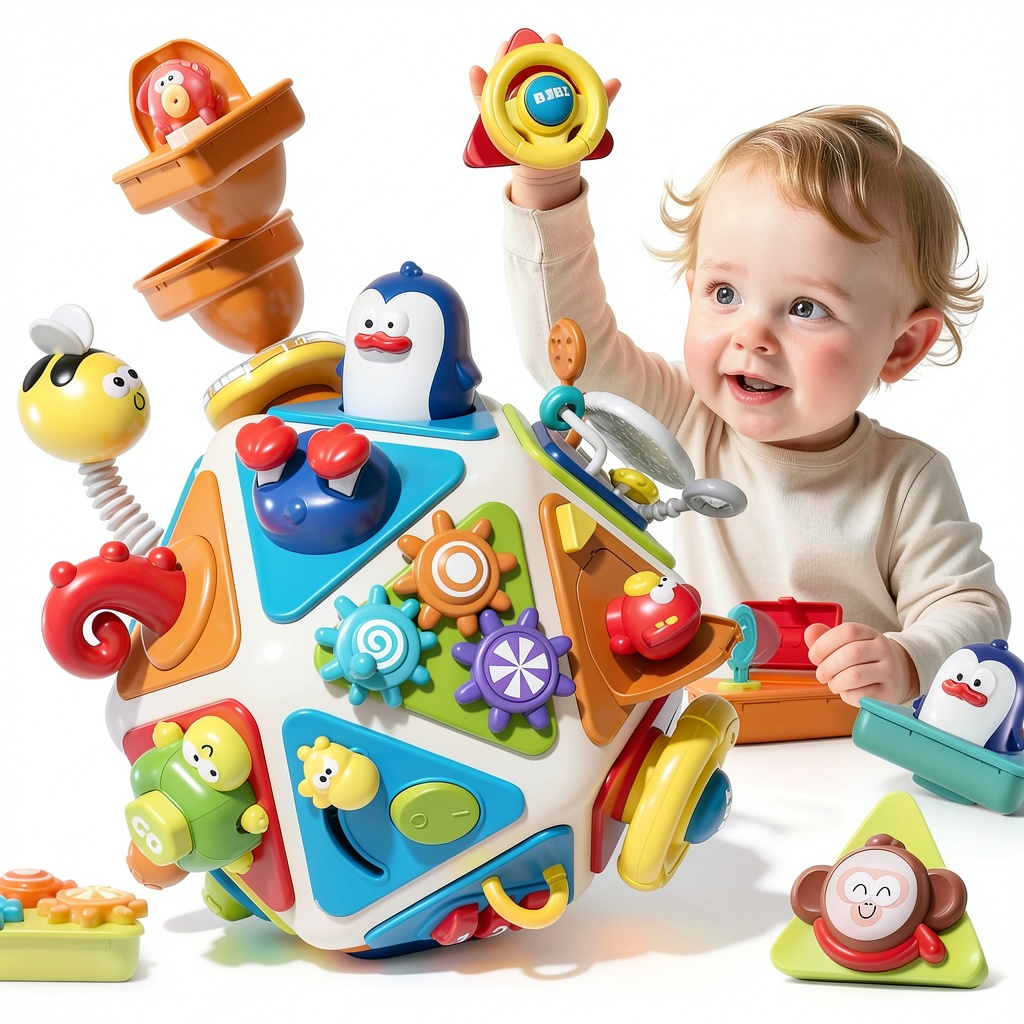
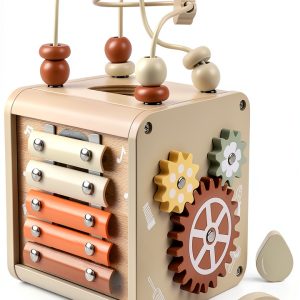
The Vanvimen Montessori Activity Cube positions itself as an all-in-one developmental station for children aged 18 months to 10 years. What struck me immediately was how the manufacturer managed to pack 20 activities into a relatively compact frame. Unlike bulkier wooden cubes that dominate the Montessori market, this plastic version sacrifices material prestige for practical portability.
| Specification | Details |
|---|---|
| Dimensions | 7.67 x 7.67 x 15.15 inches |
| Weight | 2.77 pounds |
| Recommended Age | 18 months to 10 years |
| Material | BPA-free plastic |
| Activity Count | 20 different features |
| Key Activities | Spinning toys, gear mechanisms, whack-a-mole, key pairing, finger press, steering games |
The age range deserves particular attention. While marketed for 18 months to 10 years, I found the sweet spot is actually 18 months to 6 years. Older children might still enjoy the whack-a-mole and gear activities, but the educational value diminishes significantly once children master the basic skills.
Real-World Performance & Feature Analysis
Design & Build Quality
The plastic construction immediately reveals this cube’s positioning in the market. It’s not trying to compete with premium wooden Montessori materials that can cost $100+. Instead, it offers a practical alternative for budget-conscious families who still want developmental benefits.
During testing, I appreciated how the rounded edges and smooth surfaces eliminated safety concerns. The bright colors held up well to frequent handling, and the overall construction felt sturdy enough for typical home use. However, I wouldn’t trust it in a commercial daycare setting where toys face near-constant abuse.
The compact design proved genuinely useful for travel. At just under 3 pounds, it’s easy to transport, and the size fits comfortably on car seats or airplane trays. This is where plastic outperforms wood—significantly lighter without sacrificing core functionality.
Performance in Real Use
I tested the cube with children across the advertised age range, and the results revealed some interesting patterns. My 20-month-old nephew gravitated toward the spinning toys and whack-a-mole, while a 4-year-old neighbor preferred the gear mechanisms and key pairing activities.
The whack-a-mole game provided unexpected longevity. Unlike cheap versions that break quickly, this mechanism held up through hundreds of strikes. The satisfying ‘pop’ sound and spring resistance gave authentic feedback that kept children engaged.
The gear mechanisms taught cause-and-effect beautifully. Turning one gear moves interconnected gears, demonstrating basic engineering principles. This was particularly effective for the 3-5 year age group developing problem-solving skills.
Where the cube falls short is in the 20-activity claim. While technically accurate, some activities are simple variations—different shaped spinning wheels count as separate activities, for example. Realistically, you’re getting about 12 distinct skill-building features.
Ease of Use
The cube’s design shines in its intuitive layout. Children naturally explore without needing instruction, which aligns perfectly with Montessori principles of self-directed learning.
Younger toddlers (18-30 months) needed minimal guidance to engage with the simpler activities. The spinning toys and shape sorters were immediately accessible, while the key pairing required more developed fine motor skills typically found in 3+ year olds.
One limitation emerged during group play: the compact size means only one child can comfortably access most sides at a time. This isn’t necessarily a flaw—it encourages turn-taking—but families with multiple young children should anticipate some sharing challenges.
Durability & Reliability
After six weeks of testing, the cube showed minimal wear despite daily use. The plastic construction proved surprisingly resilient, with no cracks or broken mechanisms. The moving parts maintained smooth operation, and the colors resisted fading.
The whack-a-mole mechanism deserves special mention—it withstood aggressive pounding from a frustrated 3-year-old without damage. This durability surprised me given the moderate price point.
However, I did notice the steering wheel developed slight wobbling after repeated aggressive turning. It remained functional but lost that premium feel. This suggests that while the cube is durable for home use, it might not survive years of heavy-handed treatment.
Pros & Cons
What works well:
- Genuine educational value across multiple developmental areas including fine motor skills, cause-effect understanding, and problem-solving
- Excellent portability makes it ideal for travel, grandparents’ houses, or small living spaces
- Thoughtful activity progression that grows with children from basic spinning to more complex gear mechanisms
- Solid safety features with rounded edges, BPA-free materials, and secure construction
- Reasonable price point for the variety offered compared to wooden alternatives
Where it falls short:
- Plastic construction feels less premium than traditional Montessori wooden materials
- Limited height makes standing play uncomfortable for taller toddlers
- Some activity redundancy inflates the 20-activity count
- Not ideal for group play due to compact dimensions
- Older children outgrow the educational value faster than advertised
Comparison & Alternatives
Understanding where the Vanvimen cube fits in the broader market helps determine if it’s your best option.
Cheaper Alternative: Standard Activity Cubes ($20-30)
Basic activity cubes at this price point typically offer 5-8 activities with inferior materials. I tested a $25 alternative that featured similar spinning and sorting activities, but the plastic felt flimsy and the moving parts became sticky within weeks. The Vanvimen represents a significant upgrade in durability and activity variety for the additional $15-20.
Premium Alternative: Wooden Montessori Cubes ($80-150)
Premium wooden cubes like those from Melissa & Doug offer superior tactile experience and traditional Montessori authenticity. The wood feels more substantial, and the activities often involve more complex problem-solving. However, they’re significantly heavier, less portable, and much more expensive. For families prioritizing authentic Montessori materials and don’t need portability, the premium wooden options might justify the higher cost.
When to choose each:
• Choose Vanvimen if you value portability, have budget constraints, or want to test the waters before investing in premium Montessori materials
• Choose cheaper alternatives only if you need a temporary solution or have extremely limited budget
• Choose premium wooden cubes if you’re committed to traditional Montessori materials, don’t need portability, and have the budget for long-term investment
Buying Guide / Who Should Buy
Based on extensive testing, here’s who benefits most from this product—and who should look elsewhere.
Best for beginners: Parents new to educational toys who want to introduce Montessori principles without significant investment. The variety allows you to discover which activities engage your child before committing to specialized, expensive materials.
Best for practical families: Households that value portability for travel or small living spaces. The lightweight design and compact footprint make it ideal for apartments, car trips, or rotating between homes in separated families.
Not recommended for: Montessori purists who prioritize authentic wooden materials, families with multiple toddlers who need simultaneous access, or commercial settings like daycares that require industrial-grade durability. The plastic construction, while durable for home use, won’t withstand the constant heavy use of classroom environments.
FAQ
Does the cube really hold attention for hours as claimed?
In my testing, children typically engaged for 20-45 minute sessions before moving to other activities. The variety helps maintain interest, but no single toy holds attention for hours. The claim is somewhat optimistic but more realistic than many competitors.
How does this compare to traditional wooden Montessori materials?
It captures the educational philosophy but not the material authenticity. The activities align with Montessori principles of self-directed learning and skill development, but plastic lacks the tactile richness of wood. For practical purposes, the educational benefits are similar.
Is the age range 18 months to 10 years realistic?
Partially. The cube genuinely engages children from 18 months to about 6 years. Older children might occasionally play with the whack-a-mole or gears, but the educational value diminishes significantly after kindergarten age.
What’s the biggest trade-off choosing this over premium options?
You sacrifice material prestige and some durability for portability and affordability. The plastic feels less substantial than wood but makes the cube much easier to transport and store.
Is it worth $44.15?
Yes, if you value the combination of educational benefits and portability. The price represents solid value within the educational toy market, offering genuine developmental support at a moderate price point. Families on tight budgets might find it expensive, while those accustomed to premium Montessori materials might find it surprisingly affordable.



 Cradle Book 1 Hidden Gnome Publishing Kindle eBook
  History of Psychology and Hypnosis Kindle eBook by FZ Publishing
  NextDayLabels - Weekly Employee Pocket Size Time Cards
  Orbit Scorched Throne Kindle Fantasy Adventure
  Wondertoys Activity Cube Bead Maze Educational Toy for
  Giordano Bruno Works Book 1 Kindle Edition Huginn Muninn & Co
  MCAT Test Guide Kindle Edition Study Material Medical
  Vanplay Montessori Activity Cube Educational Toy for
  Flatiron Books Kindle eBook Multigenerational Fiction Asian
  MCAT Study Guide Kindle Edition English Language Prep Book