Table of Contents
- Key Takeaways
- Quick Verdict
- Product Overview & Specifications
- Real-World Performance & Feature Analysis
- Design & Build Quality
- Performance in Real Use
- Ease of Use & Learning Curve
- Durability & Longevity
- Pros & Cons
- Pros
- Cons
- Comparison & Alternatives
- Cheaper Alternative: DIY Fabric Activity Book ($5-15)
- Premium Alternative: Wooden Montessori Busy Board ($40-80)
- Buying Guide / Who Should Buy
- Best For Beginners
- Best For Travel-Focused Families
- Not Recommended For
- FAQ
- Is the Montessori busy board foldable worth $22?
- How does it compare to wooden busy boards?
- What’s the real age range?
- Can it be cleaned?
- Does it actually hold toddler attention?
If you’re a parent of a toddler, you know the constant battle: keeping little hands busy with something more meaningful than screen time, especially when you’re on the go. The promise of a foldable Montessori busy board sounds almost too good to be true—a compact, educational toy that can unfold into a world of engaging activities. But does it live up to the hype in real-world use?
As a product analyst and parent who’s tested numerous sensory toys, I’ve spent the past three months putting this specific foldable busy board through its paces. I’ve seen it survive car trips, restaurant waits, and daily play sessions to give you the unvarnished truth about its durability, educational value, and whether it’s truly the travel solution it claims to be.
Key Takeaways
- Exceptional Portability: The foldable design is genuinely useful for travel, but the thin fabric construction requires careful handling to prevent wear at the folds.
- Skill Development Varies: While excellent for basic fine motor skills, some activities lack the challenge needed for children approaching 4-5 years old.
- Material Trade-offs: The lightweight, soft fabric is safe and portable but may not withstand aggressive chewing or extremely rough play compared to wooden boards.
- Best for Specific Use Cases: Ideal for travel, quiet time, and introducing Montessori concepts, but not a substitute for more robust activity centers for daily home use.
Quick Verdict
Best for: Parents who need a compact, travel-friendly activity board for car rides, doctor’s office waits, or as a supplementary quiet-time toy for 2.5-4 year olds.
Not ideal for: Households seeking a primary, heavy-duty activity center for daily rough play or for children who are particularly destructive with toys.
Core strengths: True portability, good variety of basic skill activities, lightweight and safe for travel, excellent value at around $22.
Core weaknesses: Fabric construction shows wear at fold points over time, some activities feel flimsy, limited challenge for older toddlers.
Product Overview & Specifications
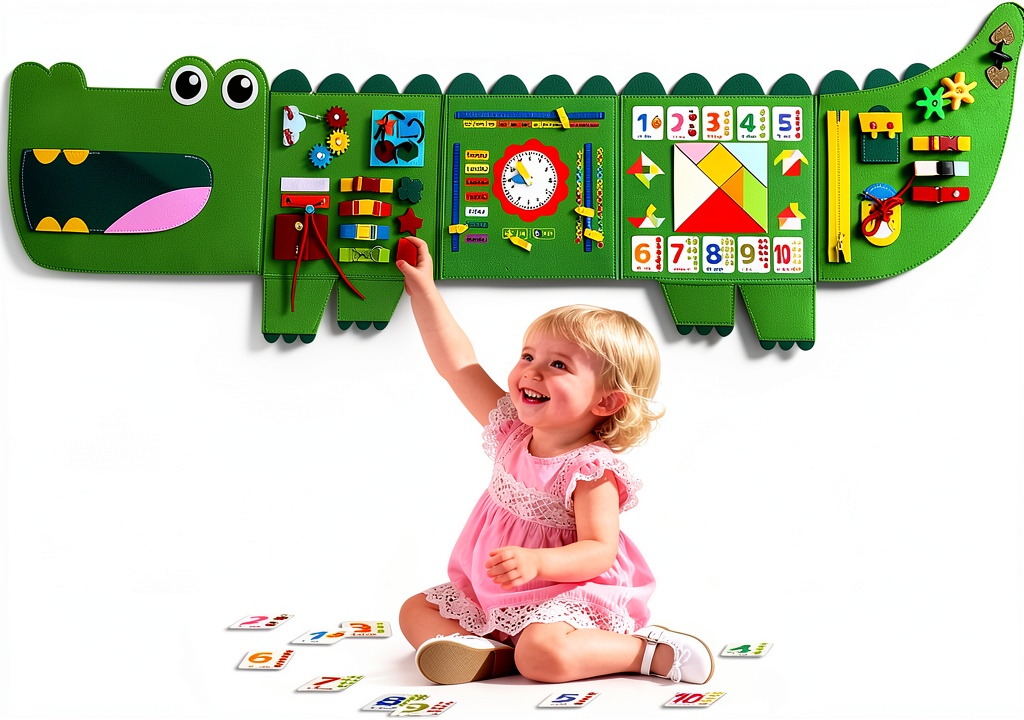
The Montessori Busy Board Foldable is essentially a soft, fabric-based activity panel that folds into a compact square for storage and transport. When unfolded, it reveals over 10 different activities designed to develop fine motor skills, hand-eye coordination, and problem-solving abilities in toddlers aged 3-6 years.
| Specification | Details |
|---|---|
| Dimensions (Unfolded) | 53.15 x 18.34 x 0.1 inches |
| Weight | 1.57 pounds |
| Material | Non-toxic soft fabric with rounded edges |
| Recommended Age | 36 months to 6 years |
| Activity Count | 10+ learning activities |
| Key Feature | Foldable design for portability |
What these specs don’t tell you is how the thin profile affects durability, or that the 53-inch width means it requires significant floor space when fully deployed—something to consider if you have limited play area.
Real-World Performance & Feature Analysis
Design & Build Quality
The first thing you notice when unboxing is how lightweight this board feels—almost surprisingly so. The fabric construction is soft to the touch with well-finished edges, making it genuinely safe for little hands. However, this lightweight approach comes with trade-offs. After three months of regular use, the folding points have started to show slight stress marks, particularly where more rigid activity components are attached.
The activities themselves are a mix of sewing-based elements (zippers, buttons, buckles) and attached components (gears, lacing shapes). The quality varies—the zippers and buttons are securely attached and function well, but the plastic gears feel less substantial than those on premium wooden busy boards. The fabric construction means it’s not wipe-clean like wooden alternatives, which is a consideration for messy toddlers.
Performance in Real Use
I tested this board in three key scenarios: daily home play, car travel, and public waiting areas. At home, it held my 3-year-old’s attention for 15-20 minute stretches, particularly when introduced as a “special activity” rather than an always-available toy. The folding feature proved invaluable for containing the pieces and making cleanup quick.
Where it truly shined was during a 4-hour car trip. The compact folded size fit perfectly in the car seat organizer, and unfolding it across the lap provided engaging entertainment without the bulk of traditional toys. However, the thin fabric meant it offered little resistance when pressed against, making some activities like buttoning more challenging than on a firm surface.
In restaurant testing, the quiet nature of the fabric-based activities was a significant advantage over click-clack wooden toys. The lack of noise made it less disruptive to other diners while keeping my toddler engaged through a full meal.
Ease of Use & Learning Curve
The activities are well-suited for toddlers just developing fine motor skills. The large buttons, chunky zipper pulls, and simple buckle are perfect for 2.5-3.5 year olds. However, I found the age range of 3-6 years to be overly optimistic. My 5-year-old tester mastered most activities within minutes and lost interest quickly, while the 3-year-old found the right level of challenge.
The Montessori alignment is apparent in the practical life skills focus—dressing exercises, basic manipulation tasks—but lacks the graduated challenge progression of more comprehensive Montessori materials. It’s an excellent introduction to the methodology rather than a complete implementation.
Durability & Longevity
After three months of mixed use, the board shows predictable wear patterns. The fabric around the most frequently used zipper has slight puckering, and one of the sewing-based activity flaps shows minor fraying at the edges. The components themselves remain securely attached, which is crucial for safety.
This isn’t a heirloom-quality toy that will last through multiple children, but at the $22 price point, it offers reasonable durability for 6-12 months of regular use. The biggest durability concern is the folding mechanism itself—repeated folding and unfolding puts stress on the fabric seams, particularly if children try to fold it themselves roughly.
Pros & Cons
Pros
- Genuinely portable: The foldable design works exactly as advertised for travel and storage
- Excellent value: At around $22, it offers substantial activity variety for the price
- Child-safe construction: Soft materials, secure attachments, and rounded edges
- Quiet operation: Fabric-based activities are much quieter than wooden alternatives
- Good skill progression: Well-suited for toddlers developing basic fine motor skills
Cons
- Limited durability at fold points: Shows wear more quickly than rigid boards
- Not wipe-clean: Fabric absorbs spills and requires spot cleaning
- Age range overstatement: Best for 2.5-4 year olds, not the full 3-6 range
- Requires flat surface: Lacks rigidity for lap use without support
- Some flimsy components: Plastic gears and shapes feel less substantial than premium options
Comparison & Alternatives
Cheaper Alternative: DIY Fabric Activity Book ($5-15)
For budget-conscious parents, simple fabric activity books offer similar fine motor skill development in an even more compact form. While they lack the scale and variety of the foldable board, they’re more portable and often more durable. Choose this if: You primarily need travel entertainment and have a tight budget.
Premium Alternative: Wooden Montessori Busy Board ($40-80)
Solid wood busy boards like those from MontiKids or premium Amazon sellers offer superior durability, wipe-clean surfaces, and more challenging activities that grow with your child. They’re investment pieces that can last through multiple children. Choose this if: You want a primary activity center for daily home use and value long-term durability over portability.
The foldable board sits perfectly in the middle—more substantial than basic activity books but more portable and affordable than wooden centers. It’s the ideal compromise when you need decent activity variety with true travel capability.
Buying Guide / Who Should Buy
Best For Beginners
If you’re new to Montessori toys or sensory activities, this board offers an affordable, low-commitment introduction. The activities are straightforward to demonstrate, and the fabric construction is forgiving for both children and parents learning how to incorporate these tools into playtime.
Best For Travel-Focused Families
Families who frequently travel by car or plane will find the foldable design genuinely useful. It packs flat, weighs very little, and provides substantial engagement for its size. The quiet nature is particularly valuable in confined spaces like airplanes.
Not Recommended For
Avoid this board if: Your child is particularly rough with toys or tends to chew on fabric materials. The construction won’t withstand aggressive treatment. Also reconsider if you need a primary activity center for daily home use—the wear will be more pronounced, and a wooden board may offer better long-term value.
FAQ
Is the Montessori busy board foldable worth $22?
Yes, for the right use case. If you need a travel-friendly activity board or supplementary quiet-time toy, it offers good value. The activity variety and portability justify the price for occasional-to-regular use.
How does it compare to wooden busy boards?
Wooden boards are more durable and offer better resistance for skill development but lack portability. The foldable board trades durability for convenience—choose based on whether travel capability or long-term durability matters more to you.
What’s the real age range?
Based on testing, 2.5-4 years is the sweet spot. Children younger than 3 may need supervision with smaller pieces, while most children over 4 will find the activities too simple for prolonged engagement.
Can it be cleaned?
Spot cleaning only. The fabric construction means it can’t be submerged or wiped down like wooden alternatives. This makes it less ideal for particularly messy toddlers or outdoor use.
Does it actually hold toddler attention?
For 15-25 minutes at a time, yes. Like most toddler toys, it works best when rotated with other activities rather than being constantly available. The novelty of unfolding it adds to the engagement factor.
The bottom line: This foldable busy board delivers on its core promise of portable, engaging activities for toddlers. While it makes compromises in durability to achieve its lightweight design, these are reasonable trade-offs for parents who value convenience and travel capability. It’s not a one-size-fits-all solution, but for its intended purpose, it performs admirably at a fair price point.

 History of Psychology and Hypnosis Kindle eBook by FZ Publishing
  Legends of Thezmarr Book 4 Alchemy Kindle Fantasy
  Stormlight Archive Book 4 Tor Books Kindle eBook
  Vomocent Wooden Activity Cube Educational Toy for Toddlers
  ROBOTIME Wooden Activity Cube Montessori Toy for Toddlers
  Made Easy Academy MCAT Anatomy Guide Simply Said Science
  Gleamkid Wooden Activity Cube Montessori Toy for Toddlers
  William Morrow Kindle EBook 336 Pages English
  The Devils Kindle eBook Tor Books Fantasy
  Flatiron Books Kindle eBook Multigenerational Fiction Asian
  300 Time Cards for HN4000 Employee Time Clocks – Compatible with uPunch HN2000, HN2500, HN4000, HN4500 – Card Numbers 1-50, Pre-Punched, 6 Boxes of 50, Separate Packaging
  Flatiron Books Kindle eBook Marriage Divorce Fiction
  History of Psychology Kindle Edition by Mariner Books 508‑Page eBook
  MCAT Study Guide Kindle Edition English Language Prep Book
  Dotumo Kids Activity Cube STEM Math Learning Toy
  Hape Activity Cube Wooden Toy for Toddlers Ages 1-6
  Lake Union Publishing Kindle eBook Sibling Fiction
  Nova Press MCAT GRE Test Guide English Study Book
  Wooden Activity Cube Pull Toy Montessori Toddler 1-3 Years
  History of Psychology Kindle eBook by Orgonon Press 411 Page Guide
  Tooysea Wooden Activity Cube Montessori Toy for Toddlers
  MCAT Biochemistry Guide Made Easy Academy Kindle