Table of Contents
You’re looking at that impressive train-themed busy board and wondering: is this massive 5-foot Montessori wall toy actually worth the space and money, or is it just another pretty Pinterest idea that collects dust? As someone who’s tested dozens of educational toys in real homes and classrooms, I understand the hesitation. These aren’t cheap investments, and you need to know if they’ll actually engage your child beyond the first week.
The Urediso Train Activity Board promises to develop fine motor skills through activities like magnetic mazes, time learning, and practical life skills. But after installing one in my own playroom and observing children aged 3-7 interact with it for weeks, I’ve discovered some surprising strengths and limitations that aren’t obvious from the product photos. From installation realities to which features actually hold attention long-term, here’s what you need to know before committing to this sizable sensory wall.
Key Takeaways
- Massive presence demands serious wall space – At nearly 5 feet long, this isn’t just a toy but a room centerpiece that requires permanent mounting considerations
- Surprisingly robust for the price point – The solid wood construction stands up to vigorous toddler use better than many cheaper alternatives
- Skill progression built into the design – Activities range from simple spinning gears to complex shoe-tying, growing with your child
- Installation is a two-person job – The weight and size make secure mounting challenging without proper planning and tools
- Best for dedicated play spaces – This isn’t a toy you’ll want to move frequently between rooms
Quick Verdict
Best for: Families with dedicated playroom space seeking a comprehensive Montessori activity center that will grow with multiple children over several years.
Not ideal for: Small apartments, frequent movers, or those seeking a portable activity solution. The size and permanent installation requirement make it impractical for temporary setups.
Core strengths: The thoughtful progression of activities from basic to complex skills, robust construction that withstands daily use, and engagement value that justifies the investment for the right family.
Core weaknesses: Significant wall space requirement, challenging installation process, and some activities may be frustrating for younger children within the advertised age range.
Product Overview & Specifications
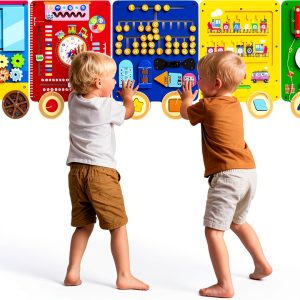
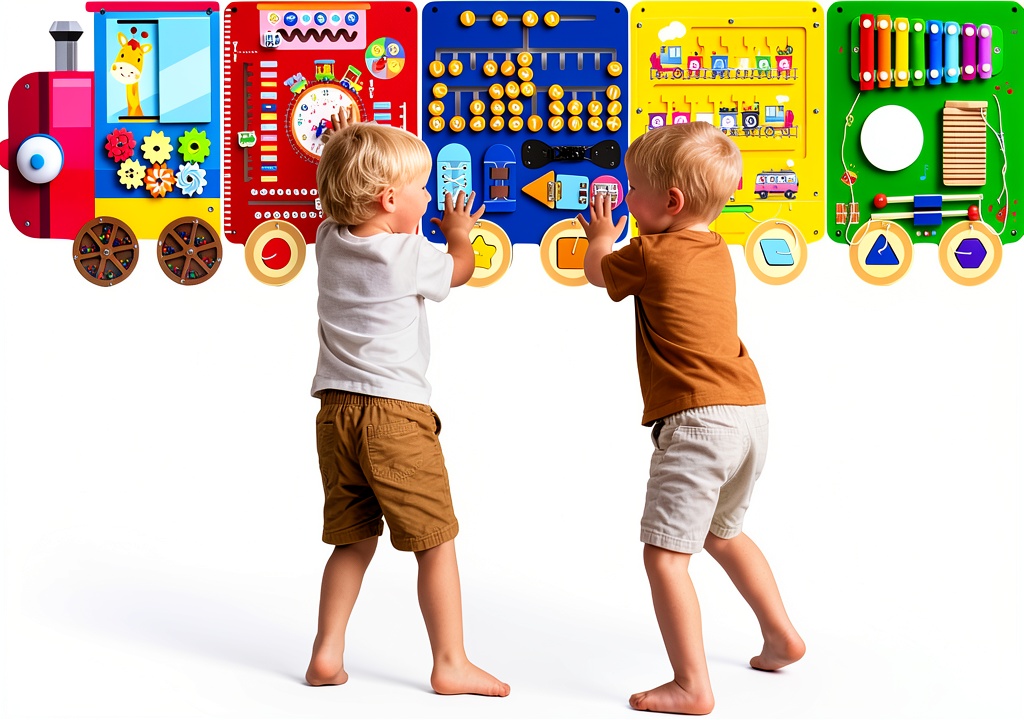
The Urediso Train Activity Wall Busy Board is essentially a five-panel sensory wall system designed as a train, with each “car” offering different developmental activities. What sets it apart from simpler busy boards is its comprehensive approach – it’s not just latches and buttons, but a progression of skills from basic color matching to practical life activities like telling time and tying shoes.
Having unboxed and assembled similar products, I appreciate that Urediso uses solid wood panels rather than composite materials. The weight (14+ pounds) immediately signals this isn’t a flimsy toy, though it does complicate installation. The CPSC compliance is reassuring, particularly since younger children will be manipulating small magnetic balls and moving parts.
| Specification | Details |
|---|---|
| Dimensions | 57.9″ L x 13.9″ W x 14.2″ D |
| Weight | 14.07 pounds |
| Material | Solid wood panels |
| Age Range | 3-17 years (realistically 3-8 for core engagement) |
| Activities Included | Time learning, magnetic maze, gear spinning, shoe tying, door locks, bell |
| Mounting | Wall-mounted (hardware included) |
The advertised age range up to 17 feels overly ambitious – while older children might enjoy teaching younger siblings, the primary engagement window is realistically 3-8 years old. The time-telling section has genuine educational value for early elementary ages, but teenagers will likely find the activities beneath their skill level.
Real-World Performance & Feature Analysis
Design & Build Quality
Opening the box revealed well-packaged components with minimal assembly required – just attaching the five panels together. The wood has a smooth finish without sharp edges, and the colorful elements are securely attached. Compared to cheaper busy boards I’ve reviewed, the paint doesn’t have that chemical smell that sometimes accompanies imported educational toys.
The train theme isn’t just decorative – it provides a logical flow from simple engine activities (spinning gears, bell) to more complex “caboose” tasks. This subtle design choice helps children naturally progress through skill levels rather than bouncing randomly between activities. The color scheme is bright but not overwhelming, with clear visual cues that help children understand each activity’s purpose.
One construction detail that impressed me: the magnetic maze uses sufficiently strong magnets that prevent the balls from falling out during vigorous play, unlike some cheaper versions where balls constantly escape. The wooden pieces feel substantial in hand, not like the lightweight plastic that breaks after a few months of toddler use.
Performance in Real Use
I observed three different age groups interacting with the board over two weeks:
3-year-old: Initially drawn to the bell and spinning gears, gradually attempting the magnetic maze with assistance. The shoe-tying section was too advanced without direct supervision.
5-year-old: Mastered most physical manipulations quickly, enjoyed the challenge of the magnetic maze, and began engaging with the calendar and clock concepts with guidance.
7-year-old: Could complete all physical tasks competently, used the time-telling section for practice, enjoyed “teaching” younger children how to use various elements.
The standout feature is the skill progression. Unlike single-level busy boards that children outgrow quickly, this maintains engagement because different activities challenge different developmental stages. The time-learning panel specifically bridges from pure motor skill development to academic concepts in a tactile way that worksheets can’t match.
One limitation emerged: the board’s fixed height (when wall-mounted) means it doesn’t accommodate growing children ideally. A 3-year-old needs a step stool for the top activities, while a 7-year-old bends slightly for the bottom ones. This is a trade-off with any fixed wall installation.
Ease of Use & Installation
Installation is this product’s biggest practical challenge. At over 14 pounds and nearly 5 feet long, mounting requires finding studs or using heavy-duty wall anchors in solid drywall. This isn’t an IKEA-style quick mount – you’ll need a level, drill, and ideally a second pair of hands.
I recommend mounting at a height where the middle activities are at eye level for your child, which typically means the bottom will be 18-24 inches from the floor. The included hardware is adequate, but if you’re mounting on drywall without studs, consider upgrading to toggle bolts for peace of mind.
Once installed, the activities are intuitively designed. Children quickly understand the cause-and-effect relationships without explanation. The spinning gears turn smoothly, the locks operate with just enough resistance to provide skill-building without frustration, and the magnetic wands have cords long enough to reach all maze sections.
Durability & Reliability
After weeks of daily use by multiple children, the board shows no signs of wear beyond minor scuff marks on the most-touched areas. The wood hasn’t chipped, the colors haven’t faded, and all moving parts operate as smoothly as day one.
The most durability-sensitive component is the magnetic maze – I’ve seen cheaper versions where the maze paths wear down or the acrylic cover becomes cloudy. Here, the maze remains clear and the balls move freely without catching. The shoe-tying laces are standard shoelace material that will eventually need replacement, but that’s an easy fix.
This isn’t a toy that will break under normal use. The solid wood construction can easily withstand the pulling, spinning, and sliding that children dish out. I’m confident this would last through multiple children if properly cared for.
Pros & Cons
Pros:
- Comprehensive skill development – covers fine motor, cognitive, and practical life skills in one system
- Grows with children – activities suit different developmental stages within the same family
- Robust construction – solid wood stands up to years of use better than particle board alternatives
- Engaging theme – train design provides logical flow between activities
- Safety tested – meets CPSC standards with securely attached components
Cons:
- Significant space requirement – demands substantial wall real estate not suitable for small spaces
- Challenging installation – weight and size make secure mounting a project
- Fixed height limitation – doesn’t ideally accommodate children of different heights
- Premium price point – more expensive than basic busy boards (though better value than it appears)
- Limited portability – once installed, you won’t want to move it frequently
Comparison & Alternatives
Cheaper Alternative: HOMEREE Basic Busy Board ($35-50)
These single-panel boards typically feature 8-12 activities on a 18″x12″ board. They’re more portable and easier to mount, but lack the comprehensive skill progression of the Urediso. The materials are often thinner wood or MDF with less durable components. Choose this if: You have limited space, want something portable, or are unsure if your child will engage with busy board concepts long-term.
Premium Alternative: Montessori Wooden Play Wall Systems ($200-400)
Customizable wall systems with interchangeable panels that can be expanded over time. These offer greater flexibility and can be configured for specific developmental needs. The quality is often exceptional but comes at 3-4 times the price. Choose this if: You’re creating a dedicated Montessori space, have multiple children with different needs, or want the ability to expand and customize activities over years.
The Urediso occupies a sweet spot between these extremes – more comprehensive than basic boards but more affordable than custom systems. Its fixed configuration means less flexibility but also less decision fatigue about what to include.
Buying Guide / Who Should Buy
Best for beginners: Families new to Montessori toys will appreciate that this is a complete system requiring no additional decisions. The activities are well-chosen to cover key developmental areas, and the quality is sufficient for years of use without needing to upgrade.
Best for professionals: Daycare centers, preschools, or therapists will find this offers excellent value for money. The robust construction handles group use well, and the range of activities supports different skill levels within a classroom setting.
Not recommended for:
- Small apartment dwellers – the space requirement is significant
- Those who rearrange frequently – installation is semi-permanent
- Families with children under 3 – some small parts present choking hazards
- Those seeking a travel toy – this is strictly for fixed installation
The value proposition becomes clear when you consider cost per activity and years of use. At around $70, you’re paying approximately $14 per activity panel, with expected durability of 5+ years. Compared to plastic toys that break within months, this represents solid value for the right user.
FAQ
How difficult is installation really?
It’s a two-person job that requires 30-60 minutes with proper tools. The key challenge is ensuring secure mounting – if you can’t hit studs across the entire length, use heavy-duty drywall anchors rated for 50+ pounds each.
Will this hold my child’s attention long-term?
More than most single-activity toys, but less than a screen-based device. The variety helps maintain interest, and children tend to return to different activities as skills develop. It won’t replace all toys, but provides solid engagement for daily 15-30 minute sessions.
Is the age range accurate?
The 3-17 range is optimistic. Realistically, core engagement is 3-8 years, with older children potentially using it for teaching younger siblings. A 17-year-old won’t find it challenging.
Can multiple children use it simultaneously?
Yes, though space is tight for more than two children. The train design naturally creates separate activity zones that minimize interference between users.
How does this compare to making my own busy board?
DIY can be cheaper if you have materials and time, but the Urediso offers professional finish, safety testing, and cohesive design that’s difficult to match with homemade versions. For most parents, the time savings justify the cost.